
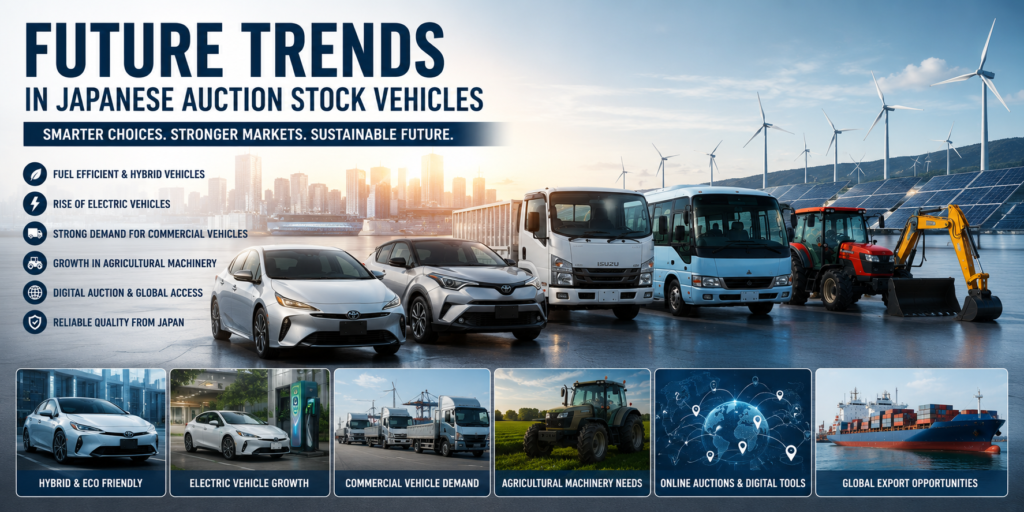
Future Trends in Japanese Auction Stock Vehicles
Search available auction vehicles here:
Browse Auction Vehicles
Why Future Trends Matter for Global Buyers
Japanese auction stock is an important source for overseas vehicle buyers. Importers, dealers, farmers, transport companies, and business owners use Japanese auctions to find cars, trucks, buses, vans, tractors, and machinery.
However, the vehicle market is changing. Buyers now look for better fuel economy, lower running costs, cleaner engines, stronger resale value, and easier online access.
Understanding future trends helps overseas buyers make better decisions. It also helps importers prepare stock that will match customer demand in the coming years.
This guide explains future trends in Japanese auction stock vehicles and how global buyers can use these changes for better sourcing.
How Japanese Used Vehicle Auctions Work
Japanese used vehicle auctions are dealer-only markets. Sellers list vehicles through auction houses across Japan, and registered members place bids.
Sellers may include used car dealers, new car dealers, leasing companies, rental companies, fleet owners, trade-in suppliers, farms, transport companies, and machinery companies.
Most overseas buyers cannot bid directly. They usually work with a Japanese export company or licensed auction member that can access auction systems and place bids on their behalf.
What Buyers Can Check in Auction Stock
- Vehicle photos
- Auction sheet
- Auction grade
- Year and mileage
- Model code
- Engine type
- Transmission
- Fuel type
- Drive system
- Body type
- Auction location
- Inspector comments
This information helps overseas buyers compare vehicles before bidding. As the market changes, buyers should also check fuel type, emissions, parts availability, and long-term demand.
Trend 1: Stronger Demand for Fuel-Efficient Vehicles
Fuel economy is becoming more important in many export markets. Fuel prices affect taxi operators, delivery businesses, private buyers, farms, and transport companies.
Japanese compact cars and hybrid models will continue to attract buyers who want lower running costs.
Popular Fuel-Efficient Vehicle Types
- Compact cars
- Hybrid cars
- Small vans
- Light trucks
- Efficient diesel vans
- Compact SUVs
Importers should watch models with good fuel economy and strong parts support. These vehicles may keep steady demand in many countries.
Trend 2: More Interest in Hybrid Vehicles
Hybrid vehicles are already popular in many markets. Toyota Prius, Toyota Aqua, Toyota Corolla Hybrid, Toyota Harrier Hybrid, and Toyota Alphard Hybrid are common examples.
Hybrid vehicles can offer better fuel economy than traditional gasoline vehicles. They are useful for city driving, taxi use, company fleets, and family use.
However, buyers must check hybrid battery condition, local repair support, and parts availability before purchase.
Trend 3: Growing EV Interest, but Market Readiness Matters
Electric vehicles are increasing in global interest. Some countries are building more charging infrastructure and creating cleaner transport policies.
Japanese auctions may gradually offer more used EVs in the future.
However, EV demand depends on each country’s infrastructure. Buyers should check charging availability, battery service options, import taxes, and customer demand before importing EVs.
Important EV Checks
- Battery condition
- Driving range
- Charging system
- Local charger availability
- Repair support
- Import rules
Trend 4: Continued Demand for Commercial Vehicles
Commercial vehicles will remain important in export markets. Trucks, vans, buses, and pickup trucks support daily business.
Many growing markets need vehicles for logistics, farming, school transport, construction, tourism, and delivery services.
Commercial Vehicles with Strong Future Demand
- Toyota Hiace
- Nissan Caravan
- Isuzu Elf
- Hino Dutro
- Mitsubishi Canter
- Hino Ranger
- Toyota Coaster
- Mitsubishi Rosa
Buyers should focus on condition, payload, engine type, parts availability, and local business needs.
Trend 5: Growing Need for Agricultural Vehicles and Machinery
Agricultural vehicles and machinery will continue to support global demand. Many countries need affordable tractors, farm trucks, mini trucks, loaders, and small machines.
Japanese compact tractors are popular because they are easy to use and suitable for small and medium farms.
Popular Agricultural Stock
- Kubota tractors
- Yanmar tractors
- Iseki tractors
- Mitsubishi tractors
- Mini trucks
- Wheel loaders
- Skid loaders
- Forklifts
Buyers should check PTO, hydraulics, tires, crawlers, attachments, and machine hours before bidding.
Trend 6: Online Auction Search Will Become More Important
Overseas buyers want faster and easier access to Japanese auction stock. Online vehicle search tools help buyers compare stock from many auction sources.
This trend will continue because buyers need quick information, clear photos, auction sheets, and estimated costs.
Online search also helps buyers find rare vehicles, compare prices, and prepare bids faster.
Purchase Flow from Japanese Auctions
Step 1: Study Market Demand
Before buying, importers should study what customers need in their local market.
- Fuel-efficient cars
- Hybrid vehicles
- 4WD vehicles
- Commercial vans
- Trucks
- Buses
- Tractors
- Machinery
Step 2: Search Auction Stock
A Japanese exporter can search auction stock by maker, model, year, mileage, fuel type, grade, body type, and price.
Step 3: Check Photos and Auction Sheet
Buyers should review photos, auction grade, repair history, rust notes, condition comments, and equipment details.
Step 4: Confirm Total Cost
The auction price is not the final cost. Buyers should calculate all costs before bidding.
- Vehicle price
- Auction fee
- Exporter service fee
- Inland transport in Japan
- Export inspection
- Shipping cost
- Marine insurance
- Import duty
- Local port charges
- Registration cost
Step 5: Place a Bid
After checking the vehicle and budget, the exporter places the bid on behalf of the buyer.
Step 6: Export and Shipping
After successful purchase, the exporter arranges inland transport, export documents, inspection, shipping booking, and document delivery.
Important Points for Future Buyers
Check Import Rules Early
Import rules can change. Buyers should check age limits, emissions, taxes, inspections, and required documents before bidding.
Understand Local Demand
A vehicle that sells well in one country may not sell well in another. Buyers should understand local roads, fuel prices, customer needs, and parts support.
Check Parts Availability
Future value depends on maintenance. Vehicles with available parts are easier to sell and operate.
Do Not Buy Only by Trend
A popular trend does not always mean the best purchase. Buyers must compare price, condition, demand, and repair support.
Why Use a Professional Japanese Export Company?
Future auction buying requires market knowledge and careful checking. A professional export company helps overseas buyers make better decisions.
Auction Access
Export companies can access dealer-only auction systems and search many vehicles across Japan.
Auction Sheet Translation
Most auction sheets are written in Japanese. Exporters can explain grades, damage marks, repair history, and inspector comments in English.
Market Advice
Experienced exporters can suggest vehicle types based on future demand, parts availability, road conditions, and export market trends.
Shipping and Documentation
Exporters arrange inland transport, export inspections, shipping booking, export certificates, bills of lading, and other documents.
Conclusion
Future trends in Japanese auction stock vehicles will be shaped by fuel economy, hybrid demand, EV interest, commercial vehicle needs, agricultural demand, and online auction search.
Overseas buyers who understand these trends can choose better vehicles and prepare stronger import strategies.
However, buyers must check auction sheets, photos, import rules, total cost, parts availability, and local market demand before bidding.
EVERY TRADING is a Japanese used vehicle export company. We export cars, trucks, buses, tractors, agricultural vehicles, and machinery to customers around the world.
Overseas buyers can search Japanese auction vehicles through our online auction vehicle search system and find suitable stock directly from Japan.
Learn more about Japanese auctions:
Japanese Car Auction Guide
Start searching your vehicle from Japan today:
Search Auction Vehicles Now


Browse Reliable Used Trucks & Buses from Japan
Carefully selected vehicles ready for export worldwide
Search 100,000+ Dealer Stock Vehicles from Japan
Access a wide selection of vehicles from Japanese dealers nationwide. Updated daily.