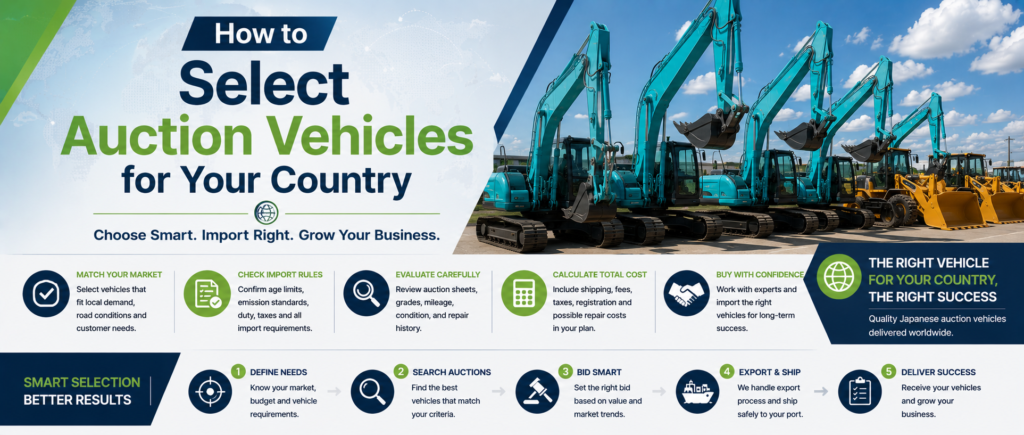
How to Select Auction Vehicles for Your Country
Search available auction vehicles here:
Browse Auction Vehicles
Introduction
Selecting the right auction vehicles for your country is one of the most important steps when importing used vehicles from Japan. Japanese auction stock offers many options, including cars, trucks, buses, vans, tractors, machinery, SUVs, and commercial vehicles.
However, not every vehicle is suitable for every country. A vehicle that sells well in one market may not be the best choice in another market. Buyers must consider local demand, import rules, road conditions, fuel quality, spare parts, customer budget, and business purpose.
Japanese auctions can give overseas buyers access to many high-quality vehicles, but careful selection is necessary. The best vehicle is not always the cheapest one. The best vehicle is the one that matches your country and your customers.
This guide explains how overseas buyers can select auction vehicles for their country. It also explains how the Japanese auction system works, the benefits, the buying flow, important risks, and why professional export support is important.
How Japanese Used Vehicle Auctions Work
Japanese used vehicle auctions are professional systems where vehicles are sold through bidding. Auction houses across Japan list many vehicles every week.
Vehicles may come from dealers, lease companies, rental fleets, private owners, business fleets, and trade-ins.
What Buyers Can Find in Auction Stock
Japanese auction stock includes many vehicle types.
- Compact cars
- Sedans
- SUVs
- Hybrid vehicles
- Commercial vans
- Light trucks
- Heavy-duty trucks
- Buses and minibuses
- Tractors
- Construction machinery
Auction Sheets and Vehicle Information
Most vehicles include auction sheets. These sheets help buyers understand vehicle condition before bidding.
Auction sheets may include:
- Mileage or hour meter
- Auction grade
- Repair history
- Rust notes
- Exterior damage
- Interior condition
- Mechanical comments
- Equipment details
Bidding System
Most auction vehicles are sold by bidding. Overseas buyers usually work with a Japanese export company that places bids on their behalf.
The buyer sets a maximum bid before the auction. If the bid wins, the vehicle is purchased. If not, the buyer can continue searching for another unit.
Why Country-Based Vehicle Selection Matters
Each country has different needs. Some countries need fuel-efficient compact cars. Others need strong trucks, buses, tractors, or SUVs.
Country-based selection helps buyers:
- Choose vehicles that customers want
- Reduce import regulation problems
- Improve resale value
- Control repair costs
- Improve long-term customer satisfaction
- Build a stronger import business
Benefits of Buying Auction Vehicles from Japan
Wide Selection
Japanese auction stock offers many vehicle choices. Buyers can compare brands, models, years, mileage, grades, body types, and prices.
Reliable Japanese Brands
Japanese brands are trusted in many countries because they are durable and practical.
Popular brands include Toyota, Nissan, Honda, Mazda, Suzuki, Mitsubishi, Isuzu, Hino, UD Trucks, Kubota, Yanmar, and Iseki.
Useful for Many Markets
Japanese vehicles can support many industries, including transport, tourism, farming, construction, logistics, taxi service, and retail business.
Good Business Value
When buyers choose vehicles that match their country, Japanese auction stock can support resale business, fleet expansion, and long-term operations.
How to Select Vehicles for Your Country
Check Import Regulations First
Before choosing any vehicle, buyers should check local import rules.
Important rules may include:
- Vehicle age limits
- Emission standards
- Steering wheel rules
- Inspection requirements
- Import duty
- Customs procedures
- Document requirements
A vehicle may be good in Japan, but it may not be allowed in your country. Always confirm import rules before bidding.
Study Local Market Demand
Buyers should understand what local customers need. For example, dealers should know which models sell quickly and which models stay in stock for a long time.
Check demand for:
- Compact cars
- Hybrid cars
- SUVs
- Pickup trucks
- Commercial vans
- Diesel trucks
- Buses
- Tractors and machinery
Check Road Conditions
Road conditions are different in each country. City roads, rural roads, mountain roads, and construction areas need different vehicles.
For rough roads, SUVs, 4WD vehicles, trucks, and strong suspension vehicles may be better. For city use, compact cars and small vans may be easier to use.
Check Fuel Quality and Fuel Cost
Fuel quality and fuel cost can affect vehicle selection. Some buyers prefer diesel trucks because they are strong for commercial work. Other buyers prefer small gasoline or hybrid cars because they are fuel-efficient.
Choose vehicles that match your local fuel supply and customer budget.
Check Spare Parts Availability
Parts availability is very important for long-term use. Vehicles with easy parts support are easier to maintain and resell.
Popular Japanese models usually have better parts supply in many countries.
Best Vehicle Types by Business Purpose
For Resale Dealers
Dealers should choose vehicles with strong local demand and good resale value.
- Compact cars
- SUVs
- Hybrid cars
- Commercial vans
- Popular trucks
For Logistics Companies
Logistics buyers should focus on loading capacity, fuel economy, reliability, and maintenance cost.
- Box trucks
- Flat body trucks
- Light trucks
- Heavy-duty trucks
- Refrigerated trucks
For Construction Businesses
Construction buyers should choose strong vehicles and machinery that can work in tough conditions.
- Dump trucks
- Crane trucks
- Flat body trucks
- Excavators
- Loaders
For Tourism Businesses
Tourism buyers should focus on passenger comfort, seating capacity, air conditioning, and interior condition.
- Microbuses
- Medium buses
- Large coaches
- Passenger vans
For Agriculture
Agricultural buyers should focus on durability, simple maintenance, and working condition.
- Tractors
- Mini trucks
- Utility vehicles
- Farm machinery
Step-by-Step Buying Flow
Step 1: Choose a Reliable Export Company
Most overseas buyers cannot access Japanese auctions directly. A professional Japanese export company helps buyers search, check, bid, and export vehicles.
Step 2: Share Your Country and Market Needs
Tell the exporter your destination country, vehicle purpose, budget, and local customer needs.
Step 3: Search Auction Stock
The exporter searches Japanese auction stock based on your country and requirements.
Step 4: Compare Vehicle Options
Compare several vehicles by price, condition, mileage, grade, body type, and total import cost.
Step 5: Check Auction Sheets and Photos
Before bidding, review auction sheets, repair history, rust notes, photos, and mechanical comments carefully.
Step 6: Decide the Maximum Bid
Set a bid limit based on market demand, local resale value, import cost, and repair risk.
Step 7: Arrange Export and Shipping
After purchase, the exporter arranges inland transport, export documents, port procedures, and shipping from Japan.
Important Risks to Avoid
Ignoring Local Import Rules
This is one of the biggest mistakes. A vehicle that does not meet import rules can create serious problems.
Buying Vehicles With Weak Local Demand
A vehicle may be cheap in Japan, but it may be hard to sell in your country.
Forgetting Total Cost
The auction price is not the final price. Buyers should calculate shipping, tax, customs, registration, and repair costs.
Choosing Rare Models
Rare models may be difficult to maintain if parts are not available locally.
Why Professional Export Support Is Important
Better Country-Based Advice
Professional exporters can help buyers choose vehicles that match destination markets and business needs.
Auction Sheet Support
Experienced exporters help buyers understand auction sheets, grades, repair history, rust notes, and condition risks.
Cost Calculation Support
A professional exporter helps buyers understand Japan-side costs, shipping costs, and estimated total import cost before bidding.
Export and Shipping Support
Export companies arrange inland transport, export documents, port handling, and shipping from Japan.
How EVERY TRADING Supports Overseas Buyers
EVERY TRADING is a Japanese used vehicle export company. We support customers around the world who want to buy vehicles from Japan.
Through Japanese auction vehicle search, overseas buyers can find cars, trucks, buses, tractors, machinery, vans, and many other vehicles from Japan auction stock.
Our team helps buyers choose vehicles for their country, understand auction sheets, compare condition, calculate costs, and arrange export from Japan safely and smoothly.
Conclusion
Selecting auction vehicles for your country requires careful planning. Buyers should check import rules, market demand, road conditions, fuel needs, parts availability, and total cost before bidding.
Japanese auction stock offers many opportunities, but the right vehicle depends on the destination market and business purpose.
With professional export support, overseas buyers can reduce risk and choose better vehicles from Japan auctions for their country.
Learn more about Japanese auctions:
Japanese Car Auction Guide
Start searching your vehicle from Japan today:
Search Auction Vehicles Now


Browse Reliable Used Trucks & Buses from Japan
Carefully selected vehicles ready for export worldwide
Search 100,000+ Dealer Stock Vehicles from Japan
Access a wide selection of vehicles from Japanese dealers nationwide. Updated daily.