
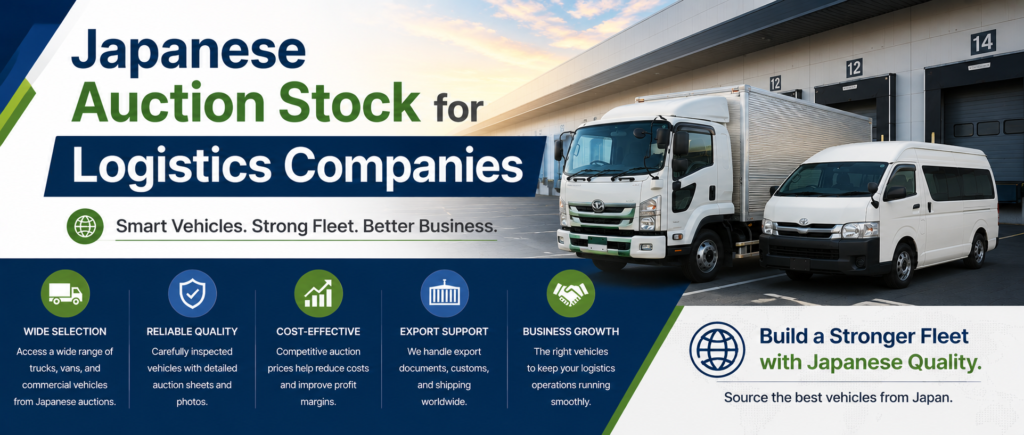
Japanese Auction Stock for Logistics Companies
Search available auction vehicles here:
Browse Auction Vehicles
Introduction
Japanese auction stock is a useful sourcing option for logistics companies that need reliable vehicles for transport, delivery, cargo movement, and fleet expansion.
Logistics companies often need different vehicle types. Some businesses need light trucks for city delivery. Others need heavy-duty trucks for long-distance cargo. Some companies need refrigerated trucks for cold-chain transport, while others need vans or flat body trucks for daily operations.
Japan’s auction market gives overseas buyers access to many vehicles across different categories. Buyers can compare mileage, condition, body type, loading capacity, auction grade, and price before bidding.
This guide explains how logistics companies can use Japanese auction stock. It also explains how the Japanese auction system works, the benefits for overseas buyers, the buying flow, important risks, and why professional export support is important.
How Japanese Auction Stock Works
Japanese used vehicle auctions are professional systems where vehicles are sold through bidding. Auction houses across Japan list many vehicles every week.
Vehicles may come from dealers, lease companies, rental fleets, private owners, trade-ins, and business fleets.
Vehicle Types Available for Logistics Companies
Logistics companies can search many vehicle types in Japanese auction stock.
- Light trucks
- Medium-duty trucks
- Heavy-duty trucks
- Flat body trucks
- Box trucks
- Refrigerated trucks
- Vans
- Wing body trucks
- Tractor heads
- Forklifts and handling equipment
Auction Sheets and Vehicle Information
Most auction vehicles include auction sheets. These sheets help buyers understand vehicle condition before bidding.
Auction sheets may include:
- Mileage
- Auction grade
- Repair history
- Rust condition
- Interior condition
- Exterior damage
- Mechanical comments
- Equipment details
Bidding System
Most Japanese auction vehicles are sold through bidding. Overseas buyers usually work with a Japanese export company that places bids on their behalf.
The buyer sets a maximum bid price. If the bid wins, the vehicle is purchased. If not, the buyer can continue searching for another unit.
Why Logistics Companies Use Japanese Auction Stock
Wide Vehicle Selection
Logistics companies need vehicles that match different transport jobs. Japanese auction stock gives buyers access to many truck sizes, body styles, and equipment types.
Reliable Japanese Brands
Japanese commercial vehicles are trusted in many countries because they are durable and practical for daily business use.
Popular brands include:
- Isuzu
- Hino
- Mitsubishi Fuso
- UD Trucks
- Toyota
- Nissan
Competitive Market Prices
Auction prices are based on bidding and market demand. Logistics companies can find good opportunities when they compare vehicle condition and total cost carefully.
Useful for Fleet Expansion
Auction stock is useful for companies that want to add vehicles to their fleet over time. Buyers can search regularly and purchase units that match their business plan.
Best Auction Stock Vehicles for Logistics Companies
Light Trucks for Local Delivery
Light trucks are useful for city delivery, small cargo transport, shop supply, and short-distance logistics.
They are easy to drive and often cost less to operate than larger trucks.
Box Trucks for Protected Cargo
Box trucks protect cargo from rain, dust, and direct sunlight. They are useful for parcel delivery, retail goods, furniture, and general cargo.
Flat Body Trucks for Flexible Transport
Flat body trucks are useful for materials, equipment, farm products, and cargo that requires easy loading and unloading.
Refrigerated Trucks for Cold-Chain Transport
Refrigerated trucks are important for food, seafood, meat, dairy, medicine, and other temperature-sensitive products.
Buyers should check the cooling unit, insulated body, rear doors, temperature range, and maintenance condition.
Heavy-Duty Trucks for Long-Distance Cargo
Heavy-duty trucks support long-distance transport, large cargo movement, container work, and industrial logistics.
Buyers should check engine condition, transmission, chassis rust, loading capacity, and shipping cost carefully.
Step-by-Step Buying Flow
Step 1: Choose a Reliable Export Company
Most overseas buyers cannot access Japanese auction systems directly. A professional Japanese export company helps logistics companies search, check, bid, and export vehicles.
Step 2: Decide Your Fleet Needs
Before searching, buyers should decide clear requirements.
- Vehicle type
- Loading capacity
- Body type
- Route distance
- Fuel type
- Transmission type
- Budget
- Destination country
Step 3: Search Auction Stock
The exporter searches Japanese auction stock based on the buyer’s request. Logistics companies should compare several vehicles before bidding.
Step 4: Check Auction Sheet and Photos
Before bidding, buyers should check all available information carefully.
- Engine condition
- Mileage
- Chassis rust
- Body condition
- Transmission notes
- Repair history
- Tire condition
- Equipment condition
Step 5: Decide the Maximum Bid
The maximum bid should match vehicle condition, total import cost, repair risk, and business value.
Buyers should include inland transport, shipping, import tax, customs charges, and possible repair costs before bidding.
Step 6: Bid and Purchase
The export company places the bid on behalf of the buyer. If the bid wins, the vehicle is purchased.
Step 7: Arrange Export and Shipping
After purchase, the exporter arranges inland transport, export documents, port procedures, and shipping from Japan.
Logistics vehicles may ship by RoRo vessel or container depending on size, quantity, and destination.
Important Points for Logistics Companies
Check Loading Capacity
Loading capacity must match daily cargo needs and local legal rules. A truck that looks strong may not legally carry the required load in the destination country.
Check Chassis and Rust
Logistics vehicles work every day, so chassis strength is very important. Heavy rust can reduce safety, resale value, and working life.
Check Fuel Economy
Fuel cost can strongly affect logistics profit. Buyers should choose vehicles that match route distance, cargo weight, and operating budget.
Check Parts Availability
Parts availability is important for fleet operation. Popular Japanese truck models usually have better parts support in many countries.
Check Import Rules
Each country has different import rules. Buyers should check age limits, emission rules, inspection rules, taxes, and required documents before bidding.
Common Risks to Avoid
Buying Only Because the Price Is Low
A cheap logistics vehicle may need expensive repairs. Buyers should focus on total value, not only auction price.
Ignoring Body Type
A logistics company must choose the right body type. A flat body, box body, refrigerated body, and wing body all serve different business needs.
Forgetting Total Import Cost
The auction price is not the final cost. Buyers should calculate shipping, taxes, customs, port charges, inland transport, and repair costs.
Not Planning Fleet Maintenance
Fleet vehicles need regular maintenance. Buyers should choose models that can be maintained easily in their market.
Why Use a Professional Export Company?
Commercial Vehicle Auction Knowledge
Professional exporters understand Japanese auction sheets, truck body types, loading capacity, and logistics vehicle risk points.
Better Condition Checking
Experienced exporters help buyers check photos, auction comments, rust notes, mileage, repair history, and specifications.
Cost Calculation Support
A professional exporter helps buyers understand Japan-side costs, shipping costs, and estimated total import cost before bidding.
Export and Shipping Support
Export companies arrange inland transport, export documents, port procedures, and shipping from Japan.
How EVERY TRADING Supports Logistics Companies
EVERY TRADING is a Japanese used vehicle export company. We support customers around the world who want to buy vehicles from Japan.
Through Japanese auction vehicle search, overseas logistics companies can find trucks, vans, refrigerated trucks, flat body trucks, buses, tractors, machinery, and other vehicles from Japan auction stock.
Our team helps buyers search suitable logistics vehicles, understand auction sheets, compare condition, calculate costs, and arrange export from Japan safely and smoothly.
Conclusion
Japanese auction stock is a strong sourcing option for logistics companies. Buyers can find light trucks, box trucks, flat body trucks, refrigerated trucks, heavy-duty trucks, vans, and other useful vehicles.
However, logistics buyers must check loading capacity, body type, engine condition, chassis rust, total cost, parts availability, and import rules before bidding.
With professional export support, overseas logistics companies can reduce risk and source better vehicles from Japan with more confidence.
Learn more about Japanese auctions:
Japanese Car Auction Guide
Start searching your vehicle from Japan today:
Search Auction Vehicles Now


Browse Reliable Used Trucks & Buses from Japan
Carefully selected vehicles ready for export worldwide
Search 100,000+ Dealer Stock Vehicles from Japan
Access a wide selection of vehicles from Japanese dealers nationwide. Updated daily.