How to Choose Safe Auction Vehicles for Export
Search available auction vehicles here:
Browse Auction Vehicles
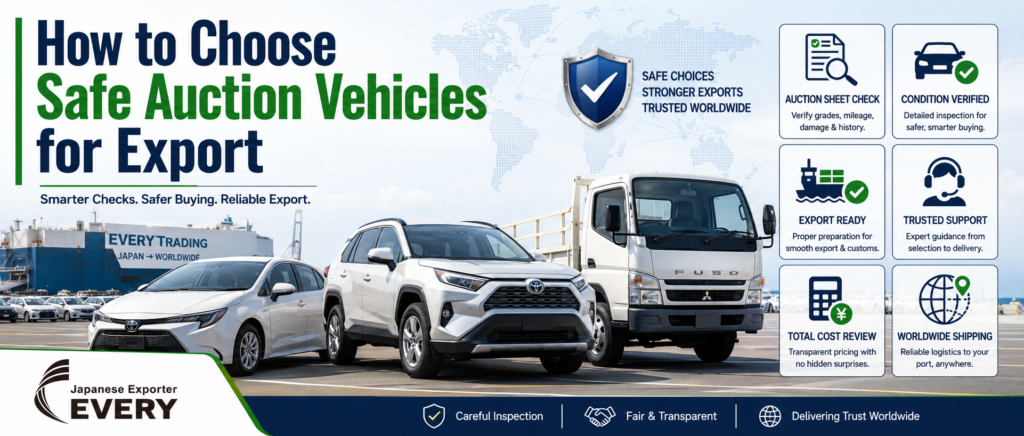
How to Choose Safe Auction Vehicles for Export
How to choose safe auction vehicles for export is one of the most important questions for overseas buyers who want to buy used vehicles from Japan. Japanese auctions offer many cars, trucks, buses, vans, tractors, machinery, and commercial vehicles, but not every vehicle is suitable for export.
Many importers, dealers, companies, transport operators, construction businesses, and farm owners use Japanese auctions because the market is large and active. Buyers can find many models and price ranges. However, safe buying requires careful checking before bidding.
A safe auction vehicle is not only a vehicle that looks clean in photos. It must have suitable condition, clear information, export compatibility, reasonable total cost, and good business value. This guide explains how overseas buyers can choose safer auction vehicles from Japan with more confidence.
1. How Japanese Used Vehicle Auctions Work
Japanese used vehicle auctions are business-to-business markets. Dealers, exporters, and vehicle companies in Japan use these auctions to buy and sell used vehicles. Many vehicles are listed regularly from different parts of Japan.
Most overseas buyers cannot join Japanese auctions directly. They usually need a Japanese export company or auction member to access auction listings, check vehicle condition, place bids, and handle export procedures.
Each auction vehicle usually includes important information. This may include photos, maker, model, year, mileage, chassis number, engine type, fuel type, transmission, body type, auction grade, and auction sheet.
The auction sheet is one of the most important documents. It gives details about the vehicle condition before bidding. It may show scratches, dents, rust, repair history, interior condition, exterior condition, warning notes, and inspector comments.
Japanese auctions use a bidding system. A buyer chooses a vehicle and sets a maximum bid price. If the bid is successful, the buyer wins the vehicle. If another buyer bids higher, the buyer does not win.
This means the final price is not fixed before the auction ends. The final price depends on vehicle condition, demand, auction grade, model popularity, mileage, and competition from other buyers.
Japanese auction stock can include many vehicle types:
- Used cars for resale and business use
- Used trucks for logistics, construction, farming, and delivery
- Used buses for schools, hotels, churches, and transport companies
- Used vans and pickups for daily work
- Used tractors for agricultural operations
- Machinery and special vehicles for work sites
For EVERY FARM TRACTOR blog readers, this is useful because farm businesses often need more than tractors. A farm may also need trucks, pickups, vans, buses, and machinery. Choosing safe auction vehicles helps protect both daily work and long-term business value.
2. Why Overseas Buyers Use Japanese Auctions
Overseas buyers use Japanese auctions because they offer wide selection. Buyers can compare many vehicles from one market and search by maker, model, year, mileage, grade, body type, fuel type, and budget.
This wide selection is useful for many business needs. A dealer may search for compact cars and SUVs for resale. A construction company may search for dump trucks or crane trucks. A school may search for buses. A farm may search for tractors, small trucks, or pickups.
Japanese vehicles are also trusted in many export markets. Buyers often choose used vehicles from Japan because they are known for reliable engines, good maintenance culture, strong resale value, and long working life.
Another benefit is the auction sheet. It gives useful condition information before bidding. This helps buyers compare vehicles and avoid some risks before purchase.
Main benefits for overseas buyers include:
- Access to a large Japanese used vehicle market
- Many options for cars, trucks, buses, tractors, and machinery
- Useful auction sheets and condition notes
- Chance to find vehicles for specific business needs
- Strong reputation of Japanese vehicle brands
- Good resale demand in many countries
- Support for importers, dealers, companies, and farm businesses
However, Japanese auctions also require careful decisions. A low price does not always mean a good deal. A vehicle must be checked for condition, export rules, total cost, and market suitability.
The best auction vehicle is not always the cheapest vehicle. The best vehicle is the one that can be exported safely, used reliably, and sold or operated with confidence in the buyer’s market.
3. What Makes an Auction Vehicle Safe for Export?
A safe auction vehicle for export should meet several important conditions. It should have clear auction information, acceptable condition, suitable documents, and no major risks that can create problems after purchase.
First, the auction sheet should be checked carefully. The sheet should give enough information about vehicle grade, mileage, repair history, rust, scratches, dents, and inspector comments.
Second, the vehicle should match the destination country rules. Some countries have age limits, inspection rules, emission standards, steering side rules, weight limits, or special document requirements. A vehicle that is good for one country may not be suitable for another.
Third, the vehicle should match the buyer’s business purpose. A car for resale should match customer demand. A truck for construction should have the correct body type and loading capacity. A bus should have safe passenger condition. A tractor should match the land and working needs.
Fourth, the total cost should be realistic. Buyers should calculate the full cost before bidding. This includes the auction price, auction fees, inland transport in Japan, documents, inspection, shipping, and local import costs.
A safe vehicle should have:
- Clear auction sheet information
- Acceptable auction grade and condition notes
- No serious hidden risk from available information
- Suitable mileage and model year
- Good export compatibility
- Reasonable total cost
- Good parts availability in the destination market
- Good business value after arrival
For work vehicles such as trucks, buses, tractors, and machinery, safety also means working strength. The vehicle must be suitable for real work, not only good appearance.
4. Check Auction Sheets Before Bidding
The auction sheet is the first major tool for choosing safe auction vehicles for export. It helps buyers understand condition before purchase. Buyers should not rely only on photos.
Photos can show the general appearance, but they may not show important details. Rust, repair history, warning lights, engine notes, or interior problems may only appear in auction sheet comments.
Important auction sheet points include:
- Auction grade
- Interior grade
- Mileage
- Model year
- Repair history
- Damage marks
- Rust and corrosion
- Inspector comments
- Engine or mechanical notes
- Special equipment notes
For cars and SUVs, buyers should check accident history, mileage, interior condition, engine notes, and rust. For compact cars and hybrid cars, buyers should also check warning lights and battery-related notes when available.
For trucks, buyers should check chassis condition, frame rust, engine condition, transmission, loading capacity, and body equipment. A clean cabin is good, but a strong chassis is more important for a work truck.
For buses, buyers should check seat condition, air conditioning, interior wear, rust, engine condition, and safety points. A bus carries passengers, so comfort and safety matter.
For tractors and machinery, buyers should check engine condition, tires, hydraulic systems, attachments, hours of use, and working condition when information is available.
Many auction sheet comments are written in Japanese. Some symbols and notes are difficult for beginners. A professional exporter can explain the meaning and help buyers avoid risky units.
5. Important Condition Checks for Safe Export
Condition checking depends on vehicle type. A safe car, safe truck, safe bus, and safe tractor have different check points. Buyers should understand what matters most for the vehicle they want.
For passenger cars, buyers should focus on accident history, engine condition, transmission, mileage, interior condition, and electrical equipment. Air conditioning and warning lights should also be checked when notes are available.
For SUVs and 4WD vehicles, buyers should check rust, underbody condition, suspension, 4WD system, accident history, and engine condition. These vehicles may be used on rough roads after export, so durability is important.
For trucks, the most important points are chassis, frame, engine, transmission, loading capacity, and body type. A truck may have scratches, but it must be strong enough for work.
For buses, buyers should check passenger safety, seat layout, air conditioning, door operation, interior condition, rust, and engine condition. A bus with poor interior or weak air conditioning may be difficult to use in hot countries.
For tractors, buyers should check horsepower, tires, attachments, engine sound, hydraulic function, and working condition. Farm users need equipment that can work, not only look good.
Important condition checks include:
- Engine and transmission condition
- Rust and corrosion
- Accident or repair history
- Interior and exterior condition
- Chassis and frame condition
- Warning lamps and electrical notes
- Special equipment condition
- Tires and suspension
- Export suitability
Safe buying means checking the vehicle based on its real use. A small scratch may be acceptable, but a serious mechanical issue can create large costs after arrival.
6. Purchase Flow: From Search to Export
The purchase flow for safe auction vehicles starts with a clear request. The buyer should tell the exporter what vehicle is needed and how it will be used.
Important details include vehicle type, maker, model, year range, mileage range, budget, fuel type, transmission, body type, destination country, and required specifications.
The basic purchase flow is:
- Buyer sends vehicle request to the exporter.
- Exporter searches Japanese auction vehicles.
- Buyer reviews photos, auction sheets, and specifications.
- Exporter explains condition and possible risks.
- Buyer checks destination country rules and total cost.
- Buyer sets a maximum bid price.
- Exporter places the bid at auction.
- If the bid wins, the vehicle is purchased.
- Buyer completes payment.
- Exporter arranges inland transport in Japan.
- Exporter prepares export documents and inspection if needed.
- Exporter books shipping from Japan.
- The vehicle is shipped to the destination port.
This process is simple to understand, but each step requires careful checking. The buyer should not rush into bidding only because the price is low or the photos look clean.
The maximum bid price should include the full business picture. Buyers should think about vehicle condition, total landed cost, local market value, possible repairs, and expected profit or work value.
After the auction is won, the vehicle is collected from the auction location and moved inside Japan. Then documents, inspection, and shipping are prepared. Shipping method depends on vehicle type, size, port, route, and destination.
7. Common Mistakes to Avoid
Many beginners make mistakes when buying auction vehicles for export. These mistakes can create extra costs, delays, or poor resale results.
One common mistake is judging only by photos. Photos are helpful, but they do not show everything. Buyers should always check auction sheets and condition notes.
Another mistake is choosing only the lowest price. A cheap vehicle may have rust, engine trouble, repair history, or export problems. A low purchase price can become expensive after repairs and shipping.
Some buyers also ignore destination country rules. This can be very serious. If the vehicle does not meet age limits, inspection rules, or document requirements, the buyer may face delays or import problems.
Common mistakes include:
- Buying only because the price is low
- Judging only by photos
- Ignoring auction sheet comments
- Ignoring rust or repair history
- Bidding too high without checking total cost
- Not checking import rules before bidding
- Choosing a model with poor parts support locally
- Buying a vehicle that does not match business use
Buyers should also avoid emotional bidding. It is easy to want to win a vehicle, but winning at the wrong price is not good business. If the price becomes too high, it is better to wait for another vehicle.
Japan has many auction vehicles. Patience and careful checking can help buyers choose safer vehicles and protect their business.
8. Auction Stock vs Dealer Stock
Auction stock is useful when buyers want wide selection. It can help buyers find specific models, special truck bodies, buses with certain seat capacity, tractors with specific horsepower, or vehicles at different price levels.
However, auction stock uses bidding. The final price is not fixed before the auction ends. The buyer may win or lose the vehicle. The process may also take time if the buyer has very specific requirements.
Dealer stock is different. Dealer stock vehicles are already available for direct purchase. The price is fixed, and the buyer can make a faster decision.
Dealer stock has three strong benefits:
- Immediate purchase is possible.
- The price is fixed.
- Export preparation can start quickly.
For buyers who need speed and simplicity, dealer stock can be a strong option. A dealer may have a customer waiting. A company may need a work vehicle quickly. A farm may need a tractor, truck, or pickup before the busy season.
Auction stock offers more choice. Dealer stock offers speed, trust, and simple pricing. Many experienced buyers use both routes. They check dealer stock first for fast purchase. If the right vehicle is not available, they search Japanese auctions with professional support.
9. Why Use a Professional Japanese Export Company?
Using a professional Japanese export company is one of the safest ways to choose auction vehicles for export. Auction buying has many details, and beginners may not understand all risks.
A professional exporter helps buyers search vehicles, read auction sheets, understand condition, check export suitability, set bid prices, handle payment, prepare documents, and arrange shipping.
This support is important because overseas buyers usually cannot inspect the vehicle in person. They need clear information and honest advice before bidding.
A professional export company can support:
- Vehicle search from Japanese auctions
- Auction sheet explanation
- Condition checking and risk advice
- Destination country rule checking
- Total cost and bid price advice
- Auction bidding support
- Payment and purchase handling
- Inland transport in Japan
- Export document preparation
- Inspection support
- Shipping arrangement
- Updates until shipment
Trust is very important in international vehicle trade. A good exporter does not only help buyers win a vehicle. It helps buyers choose the right vehicle, avoid risky units, and export smoothly from Japan.
For buyers in Africa, the Caribbean, Asia, the Middle East, and other regions, professional support can reduce risk, save time, and make the import process easier.
10. How EVERY TRADING Supports Overseas Buyers
EVERY TRADING is a Japanese used vehicle export company. The company supports overseas buyers who want to buy vehicles from Japan, including cars, hybrid cars, electric vehicles, SUVs, trucks, buses, tractors, vans, machinery, and commercial vehicles.
EVERY TRADING exports vehicles to customers around the world. Buyers can search Japanese auction vehicles and compare available options based on their budget, destination, and business purpose.
For buyers who want to choose safe auction vehicles for export, professional support is very important. EVERY TRADING helps buyers check auction information, understand vehicle condition, and move forward with more confidence.
Whether you are an importer, dealer, company buyer, transport operator, construction business, farm owner, or individual business buyer, Japanese auction vehicles can help you find reliable stock from Japan.
Learn more about Japanese auctions:
Japanese Car Auction Guide
Start searching your vehicle from Japan today:
Search Auction Vehicles Now
Conclusion
How to choose safe auction vehicles for export is about more than finding a low price. Buyers should check auction sheets, vehicle condition, import rules, total cost, shipping needs, and business value before bidding.
Japanese auctions offer many opportunities for overseas buyers. They include cars, trucks, buses, vans, tractors, machinery, hybrid cars, electric vehicles, and special-purpose vehicles.
However, auction buying requires careful checking and professional support. A safe vehicle is one that matches condition, export rules, budget, market demand, and long-term business purpose.
With support from a professional Japanese export company like EVERY TRADING, overseas buyers can search, check, bid, buy, and export vehicles from Japan with more confidence, speed, and trust.


Browse Reliable Used Trucks & Buses from Japan
Carefully selected vehicles ready for export worldwide
Search 100,000+ Dealer Stock Vehicles from Japan
Access a wide selection of vehicles from Japanese dealers nationwide. Updated daily.