
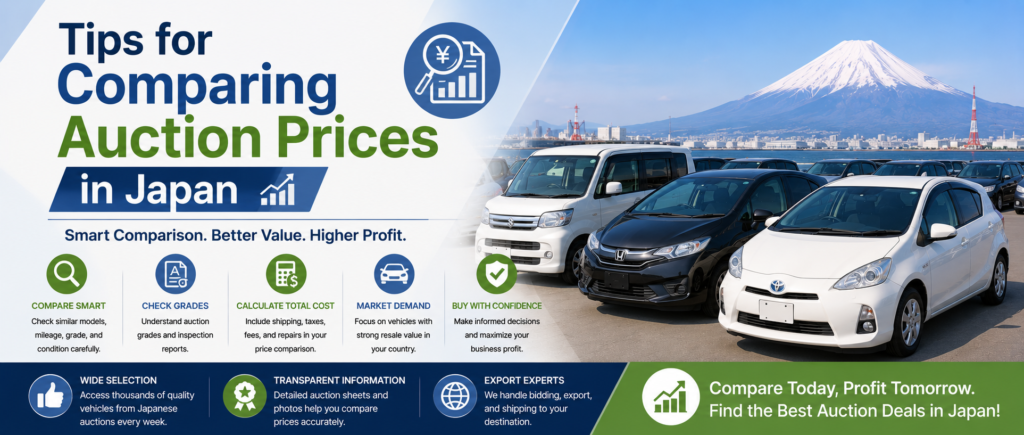
Tips for Comparing Auction Prices in Japan
Search available auction vehicles here:
Browse Auction Vehicles
Introduction
Comparing auction prices in Japan is very important for overseas buyers. Japanese auction stock offers many used vehicles every week, including cars, trucks, buses, tractors, vans, and machinery.
Many buyers look for the lowest auction price. However, the cheapest vehicle is not always the best choice. A good purchase depends on condition, mileage, auction grade, repair history, shipping cost, import cost, and resale value.
For importers and dealers, price comparison is a key skill. It helps buyers avoid overpaying, protect profit, and choose vehicles that match local market demand.
This guide explains useful tips for comparing auction prices in Japan. It also explains how the Japanese auction system works, the benefits for overseas buyers, the buying flow, important risks, and why professional export support is important.
How the Japanese Used Vehicle Auction System Works
Japanese used vehicle auctions are professional systems where vehicles are sold through bidding. Auction houses across Japan list many vehicles every week.
Vehicles may come from dealers, lease companies, rental companies, trade-ins, private owners, and business fleets.
What Information Is Included in Auction Listings?
Auction listings usually include:
- Maker and model
- Year
- Mileage or hour meter
- Engine size
- Fuel type
- Transmission type
- Auction grade
- Repair history
- Interior condition
- Exterior condition
- Photos
- Inspector comments
What Is an Auction Sheet?
An auction sheet is a condition report. It helps buyers understand the vehicle before bidding.
The sheet may show scratches, dents, rust, repair history, interior wear, mechanical notes, and grade information.
How Bidding Affects Price
Auction prices change based on demand. If many buyers want the same vehicle, the price may rise. If demand is low, the final price may be lower.
This is why buyers should compare several similar vehicles before deciding a bid price.
Benefits of Japanese Auction Stock for Overseas Buyers
Large Vehicle Selection
Japanese auction stock offers a wide choice of vehicles. Buyers can compare many brands, models, years, grades, and prices.
Market-Based Prices
Auction prices are based on real market demand. This helps buyers understand the current value of different vehicles.
Fresh Stock Every Week
New vehicles enter Japanese auctions often. Buyers do not need to rush if the price is too high. They can wait for another similar unit.
Useful for Resale Business
For dealers and importers, auction price comparison helps build better profit plans.
Why Comparing Only the Auction Price Is Risky
The auction price is only one part of the total cost. A vehicle with a low auction price may become expensive after shipping, repairs, taxes, and local registration.
Buyers should compare the full cost, not only the bid price.
Total Cost Items to Check
- Auction purchase price
- Exporter service fee
- Inland transport in Japan
- Port charges
- Shipping cost
- Import duty
- Customs clearance
- Repair cost
- Registration cost
Tips for Comparing Auction Prices in Japan
Compare the Same Model and Similar Year
Do not compare completely different vehicles. A compact car and an SUV cannot be compared fairly. A truck and a bus also have different value points.
Start by comparing the same model or similar models within a close year range.
Compare Mileage or Hour Meter
Mileage can strongly affect price. A lower-mileage vehicle usually costs more than a higher-mileage vehicle.
For tractors and machinery, check the hour meter instead of mileage.
Compare Auction Grades
A higher auction grade usually means better condition. It may also bring a higher price.
However, buyers should not judge by grade only. Photos and inspection comments are also important.
Compare Repair History
Vehicles with repair history may sell for lower prices. This can be an opportunity or a risk.
Minor repair may be acceptable in some markets. Structural repair or accident history may reduce resale value.
Compare Rust Condition
Rust can greatly affect vehicle value, especially for trucks, buses, tractors, and machinery.
A lower-priced vehicle with heavy rust may become expensive after repair.
Compare Equipment and Options
Equipment can change value. For example, a refrigerated truck with a working cooling unit has different value from a normal box truck.
Compare important options such as:
- 4WD
- Automatic transmission
- Air conditioning
- Hybrid system
- Crane equipment
- Dump body
- Refrigeration unit
- Attachments
How to Compare Prices by Vehicle Type
Passenger Cars
For cars, compare mileage, grade, repair history, fuel economy, and model popularity.
Popular models may sell faster in overseas markets, even if the auction price is slightly higher.
Trucks
For trucks, compare engine condition, chassis rust, body type, loading capacity, and equipment.
A cheap truck with chassis rust or hydraulic problems can create high repair costs.
Buses
For buses, compare seating capacity, interior condition, air conditioning, engine condition, and mileage.
Tourism buses need better interior quality because passengers expect comfort.
Tractors and Machinery
For tractors and machinery, compare hour meter, working condition, hydraulics, attachments, tires, and parts availability.
Step-by-Step Buying Flow
Step 1: Choose a Reliable Export Company
Most overseas buyers cannot access Japanese auctions directly. A professional Japanese export company helps buyers search, compare, bid, and export vehicles.
Step 2: Decide Your Budget
Before searching, decide your total budget. Include purchase price, shipping, taxes, and repair costs.
Step 3: Search Similar Vehicles
The exporter searches Japanese auction stock based on your vehicle type and budget.
Buyers should compare several similar units before bidding.
Step 4: Review Auction Sheets and Photos
Before comparing prices, check the condition of each vehicle carefully.
- Auction grade
- Mileage
- Repair history
- Rust condition
- Interior condition
- Mechanical comments
- Photos
Step 5: Decide a Fair Bid Price
After comparing condition and total cost, decide the maximum bid price.
Do not bid only because you want to win. Bid based on value.
Step 6: Bid and Purchase
The export company places the bid on behalf of the buyer. If the bid wins, the vehicle is purchased.
Step 7: Arrange Export and Shipping
After purchase, the exporter arranges inland transport, export documents, port procedures, and shipping from Japan.
Important Risks to Avoid
Comparing Different Conditions
Two vehicles may look similar, but their conditions may be very different.
Always compare condition together with price.
Ignoring Total Cost
A cheap auction price may not be cheap after shipping, tax, and repair.
Overbidding
Auction bidding can move quickly. Buyers should set a maximum price before bidding.
Ignoring Local Resale Value
A vehicle may be cheap in Japan but hard to sell in your country.
Always check local demand before bidding.
Why Professional Export Companies Are Important
They Understand Market Prices
Professional exporters watch Japanese auctions regularly. They can help buyers understand realistic price ranges.
They Explain Auction Sheets
Experienced exporters can explain grades, repair history, rust notes, and condition comments.
They Help Compare True Value
Professional exporters help buyers compare price, condition, total cost, and resale value together.
They Handle Export Procedures
Export companies arrange inland transport, export documents, port procedures, and shipping from Japan.
How EVERY TRADING Supports Overseas Buyers
EVERY TRADING is a Japanese used vehicle export company. We support customers around the world who want to buy vehicles from Japan.
Through Japanese auction vehicle search, overseas buyers can compare cars, trucks, buses, tractors, machinery, and many other vehicles from Japan auction stock.
Our team helps buyers understand auction prices, compare condition, calculate total costs, decide bid prices, and arrange export from Japan safely and smoothly.
Conclusion
Comparing auction prices in Japan is not only about finding the lowest price. Buyers must compare condition, mileage, grade, repair history, equipment, shipping cost, and resale value.
Japanese auction stock offers many opportunities for overseas buyers, but smart comparison is necessary for safe and profitable buying.
With professional export support, buyers can compare auction prices more accurately and buy vehicles from Japan with confidence.
Learn more about Japanese auctions:
Japanese Car Auction Guide
Start searching your vehicle from Japan today:
Search Auction Vehicles Now


Browse Reliable Used Trucks & Buses from Japan
Carefully selected vehicles ready for export worldwide
Search 100,000+ Dealer Stock Vehicles from Japan
Access a wide selection of vehicles from Japanese dealers nationwide. Updated daily.