
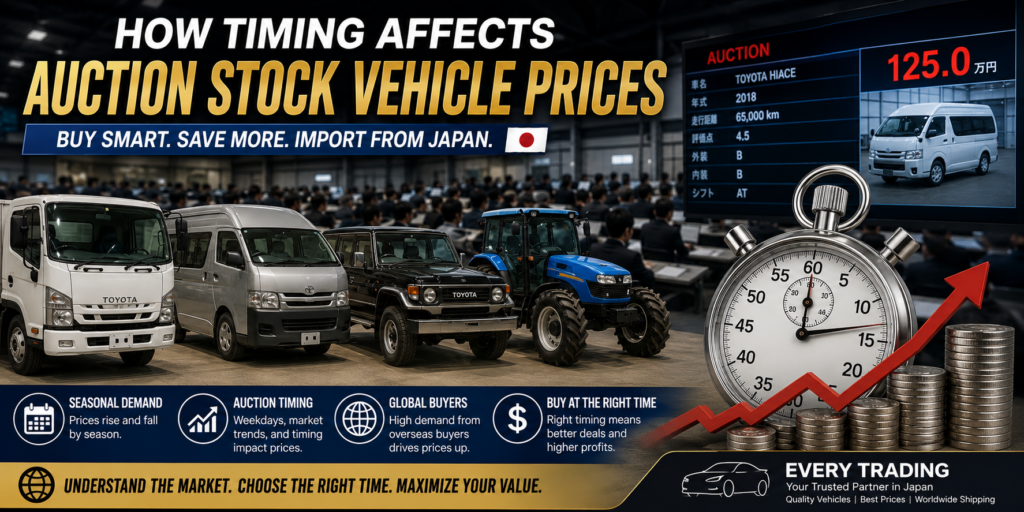
How Timing Affects Auction Stock Vehicle Prices
Search available auction vehicles here:
Browse Auction Vehicles
Why Timing Matters in Japanese Vehicle Auctions
Timing is one of the most important factors in Japanese used vehicle auctions. The same vehicle model may sell at different prices depending on the season, auction day, exchange rate, demand, and stock volume.
For overseas buyers, understanding timing can help reduce costs and improve buying results. It can also help importers, dealers, and business buyers plan better stock purchases from Japan.
Japanese auctions offer many types of vehicles, including cars, trucks, buses, tractors, and machinery. However, prices are not fixed. They move based on supply and demand.
This guide explains how timing affects Japanese auction stock vehicle prices and how overseas buyers can use this knowledge for smarter buying.
How Japanese Used Vehicle Auctions Work
Japanese vehicle auctions are large dealer-only markets. Vehicles are listed by sellers such as dealers, leasing companies, rental companies, trade-in centers, and fleet owners.
Most auctions are not open to private overseas buyers. Buyers usually need a licensed Japanese exporter or auction member to bid.
Main Information Shown in Auctions
- Vehicle maker and model
- Model code and chassis number
- Year and mileage
- Engine type
- Transmission
- Auction grade
- Inspection sheet
- Photos
- Start price
- Auction date and location
This information helps buyers compare vehicles before placing bids.
How Prices Are Decided
Auction prices are decided by live bidding. If many buyers want the same vehicle, the price rises. If demand is low, the vehicle may sell at a lower price.
This is why timing matters. A good buying moment can create a better price opportunity.
Seasonal Timing and Auction Prices
High Demand Seasons
Some seasons bring higher demand. During these periods, popular vehicles may become more expensive.
For example, commercial trucks may rise when businesses prepare for new projects. Farm tractors may become more popular before planting seasons in some export markets.
SUVs and 4WD vehicles can also increase in price when demand grows in regions with rough roads or rainy seasons.
Low Demand Seasons
At other times, demand may slow down. This can create better opportunities for buyers.
When fewer buyers are active, prices may become more reasonable. However, good vehicles can still attract strong bidding.
Overseas buyers should not only wait for cheap prices. They should also watch stock quality and shipping timing.
Auction Day Timing
Different auction houses hold auctions on different days. Some days have very large stock. Other days have smaller but more specialized inventory.
Large Auction Days
Large auction days give buyers more choices. More stock can mean better price comparison.
However, large auctions also attract many buyers. Popular vehicles may still sell at high prices.
Smaller Auction Days
Smaller auction days may offer hidden opportunities. Some buyers focus only on major auction days and miss smaller auctions.
Professional exporters often check many auction houses to find better timing and better vehicles.
Stock Volume and Price Movement
Stock volume has a direct effect on auction prices.
When many similar vehicles are listed at the same time, buyers have more choices. This can reduce pressure and may keep prices stable.
When only a few units are available, bidding can become stronger.
Example of Stock Impact
If many Toyota Hiace vans are listed in one week, buyers can compare condition and price easily. But if only one clean diesel 4WD unit appears, many buyers may compete for it.
The same idea applies to trucks, buses, tractors, and rare vehicles.
Exchange Rates and Overseas Buyer Demand
Exchange rates can also affect auction prices. When the Japanese yen is weaker, overseas buyers may have stronger purchasing power.
This can increase demand from international buyers. As a result, popular export models may become more competitive at auction.
When exchange rates change suddenly, buyers should review their total budget before bidding.
Export Market Demand
Auction prices are also affected by demand from export countries.
For example, if many buyers from Africa, the Caribbean, Asia, or Oceania search for the same truck model, prices may increase.
Popular Export Vehicles
- Toyota Hiace
- Toyota Coaster
- Hino Ranger
- Hino Dutro
- Isuzu Elf
- Mitsubishi Canter
- Toyota Land Cruiser
- Kubota tractors
- Yanmar tractors
These vehicles often have strong demand because they are reliable, easy to maintain, and suitable for business use.
Best Timing for Overseas Buyers
Search Before You Need the Vehicle
Do not wait until the last moment. Good buying requires time.
If you need stock for your business, start searching early. This gives you more chances to compare vehicles and avoid high-pressure bidding.
Watch the Market Every Week
Auction prices change weekly. Buyers who check the market often can understand normal price ranges.
This helps them know when a vehicle is overpriced or when it is a good opportunity.
Set a Maximum Bid
Before bidding, always decide your maximum price.
This helps you avoid paying too much during competitive auctions.
Purchase Flow from Japanese Auctions
Step 1: Search Auction Stock
First, search available vehicles by maker, model, year, mileage, body type, or model code.
Step 2: Check Vehicle Condition
Review photos and the auction sheet carefully. Check grade, rust, repair history, engine comments, and body condition.
Step 3: Confirm Total Cost
The auction price is not the final cost. Buyers must also consider export fees, shipping, inspection, and import charges.
Step 4: Place a Bid
Your exporter places the bid based on your budget. If the bid wins, the vehicle is purchased.
Step 5: Export and Shipping
After purchase, the vehicle is transported to port, prepared for export, and shipped to the destination country.
Important Points to Watch
- Do not judge price only by the starting price.
- Check auction grade and inspection comments.
- Confirm import rules before bidding.
- Understand shipping schedules.
- Avoid emotional bidding.
- Compare similar vehicles before deciding.
Timing can help buyers save money, but condition is still very important.
Why Use a Professional Japanese Export Company?
Japanese auctions can be difficult for overseas buyers. A professional export company helps buyers understand stock, timing, prices, and risks.
Market Price Advice
Experienced exporters know current auction trends. They can advise whether the price is reasonable or too high.
Auction Sheet Support
Auction sheets are usually written in Japanese. Exporters can explain important points clearly in English.
Safe Bidding
A professional exporter helps buyers set a smart bidding limit. This reduces the risk of overpaying.
Export Handling
After purchase, exporters manage documents, inland transport, port procedures, and shipping arrangements.
Conclusion
Timing has a strong effect on Japanese auction stock vehicle prices. Season, stock volume, auction day, exchange rates, and overseas demand can all change the final bid price.
For overseas buyers, the best strategy is to search regularly, understand market prices, check condition carefully, and work with a trusted exporter.
EVERY TRADING is a Japanese used vehicle export company. We export cars, trucks, buses, tractors, and machinery to customers around the world.
Overseas buyers can also search Japanese auction vehicles through our online auction vehicle search system and find suitable stock directly from Japan.
Learn more about Japanese auctions:
Japanese Car Auction Guide
Start searching your vehicle from Japan today:
Search Auction Vehicles Now


Browse Reliable Used Trucks & Buses from Japan
Carefully selected vehicles ready for export worldwide
Search 100,000+ Dealer Stock Vehicles from Japan
Access a wide selection of vehicles from Japanese dealers nationwide. Updated daily.